| |
|
 |

|
Fractals
by John Briggs
In Fractals: The Patterns of Chaos, science writer John Briggs uses over 170 illustrations to clearly
explain the significance -- and more importantly, the beauty -- of fractals. He describes how fractals
were discovered, how they are formed, and the unique properties different fractals share. 'Fractals' is a
breathtaking guided tour of a brand new aesthetic of art, science, and nature. It will revolutionize the
way you see the world and your place within it.
|
|
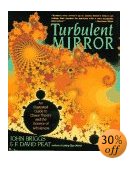
Turbulent Mirror: An Illustrated Guide to Chaos Theory and the Science of Wholeness
by John Briggs and F. David Peat
Turbulent Mirror introduces us to the scientists involved in studying this endlessly strange field;
to the theories that are turning our perception of the world on its head; and to the discoveries
in mathematics, biology, and physics that are heralding a revolution... With practical applications
ranging from the control of traffic flow and the development of artifical intelligence to the treatment
of heart attacks and schizophrenia, chaos promises to be an increasingly rewarding area of inquiry --
of interest to everyone.
|
|
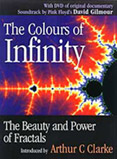
The Colours of Infinity
by Ian Stewart with Aurthur C. Clarke, Benoit Mandelbrot, Michael Barnsley, et al.
The beauty and color of fractals is captured in a documentary also included on the DVD accompanying this unique and
informative book. Introduced by Arthur C. Clarke, The Colours Of Infinity has received world-wide television
coverage and ten years ago brought the subject of fractals to the general public for the first time: geometric
exploration is brought to the general reader's attention here, in a fine and highly recommended survey of fractual
creations and math.
|
|
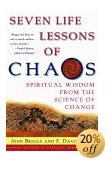
Seven Life Lessons of Chaos : Spiritual Wisdom from the Science of Change
by John Briggs and F. David Peat
The seed aspects of chaos theory are brilliantly integrated in this book into a broad perspective
illuminating the nature of deep creativity. Chaos emerges not as a negative force, but as a perpetual
and comprehensive creative process linking all aspects of life. Electrifying.
Makes chaos not only understandable but actually usable. These seven lessons are worth taking-and taking to heart.
|
|
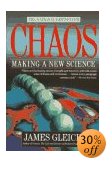
Chaos: Making a New Science
by James Gleick
Gleick here adventurously attempts to describe the revolutionary science of "chaos," a challengingly
abstract new look at nature in terms of nonlinear dynamics. "A ground-breaking book about what seems
to be the future of physics... This is not a purely technical book. Instead, it focuses as much on the
scientists studying chaos as on the chaos itself. In the pages of Gleick's book, the reader meets dozens
of extraordinary and eccentric people.
|
|
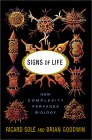
Signs of Life: How Complexity Pervades Biology
by Ricard V. Sole and Brian Goodwin
Signs of Life applies complexity to the whole of biology-from molecules to Gaia-and sets a revolutionary
new agenda for complexity theory, evolution, and development. Signs of Life is an entirely new approach
to the problems of understanding living systems. It applies the mathematics of order and disorder, of
entropy, chance, and randomness, of chaos and nonlinear dynamics to the various mysteries of the living
world at all levels... This book will help set the agenda for biology in the coming century.
|
|
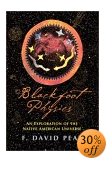
Blackfoot Physics: A Journey into the Native American Worldview
by F. David Peat
In an edifying synthesis of anthropology, history, metaphysics, cosmology, complexity and quantum theory, Peat
compares the medicines, the myths, the languages, indeed the entire perceptions of reality of the
Western and indigenous peoples. What becomes apparent is the amazing resemblance between indigenous
teachings and some of the insights that are emerging from modern science, a congruence that is as
enlightening about the physical universe as it is about the circular evolution of humanity's
understanding.
|
|
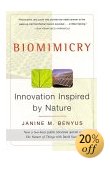
Biomimicry: Innovation Inspired by Nature
by Janine Benyus
Biomimicry is a revolutionary new science that analyzes nature's best ideas --
spider silk and prairie grass, seashells and brain cells -- and adapts them for human use. Science writer
and lecturer Janine Benyus takes us into the lab and out in the field with the maverick researchers who
are applying nature's ingenious solutions to the problem of human survival: stirring vats of proteins to
unleash their signaling power in computers; analyzing how spiders manufacture a waterproof fiber five
times stronger than steel; studying how electrons in a leaf cell convert sunlight to fuel in trillionths
of a second; discovering miracle drugs by observing what animals eat -- and much more.
|
|
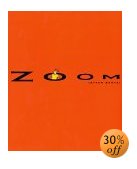
Zoom
by Istvan Banyai
A wordless picture book presents a series of scenes, each one from farther away,
showing, for example, a girl playing with toys which is actually a picture on a magazine cover,
which is part of a sign on a bus, and so on. A fun illustration of the fractal principles of scaling
that will entertain viewers of all ages.
|

|
|
|
|
|
|